
Beyond the Click: Engineering the New ROI for Paid Media Campaigns
By the Chief Digital Execution Strategist and Attribution Scientist at Elevion
The fiduciary duty of a marketing leader is not to spend a budget, but to deploy capital. This distinction is the chasm separating the vast majority of digital media campaigns from those that generate predictable, compounding financial returns. For too long, paid media has been treated as a spending pool, optimized by proxies and vanity metrics. At Elevion, we view every dollar of media spend as a precise financial instrument, and our core mandate is to enforce causal financial accountability across the entire marketing portfolio.
I. The Vanity Metrics Trap: Why the Click is a Cost, Not a Conversion

The prevailing model of media optimization is fundamentally flawed because it is a failure of causal attribution. The industry’s reliance on activity metrics—clicks, impressions, cost-per-lead (CPL), or even simple cost-per-acquisition (CPA)—is a self-imposed limitation that guarantees capital misallocation.
A click is merely a cost center; it is the beginning of the customer journey, not the end of the financial equation. When optimization stops at the point of conversion (e.g., a sign-up or first purchase), it fails to account for the most critical post-acquisition variables: churn, retention, and ultimate profitability.
This short-sighted focus creates a perverse incentive structure. Media platforms are incentivized to deliver the cheapest, fastest conversion, regardless of the customer’s quality or long-term value. The result is a high-volume, low-quality customer base that rapidly erodes the perceived ROI. The media spend appears efficient on paper, but the business suffers from a systemic failure to connect the initial media exposure to the final, realized Lifetime Value (LTV). This is not marketing; it is capital destruction masked by favorable front-end metrics.
II. The Causal Attribution Mandate: Measuring Incrementality

To transition from spending to investing, we must move beyond correlational metrics to causal financial outcomes. The true measure of media effectiveness is Incrementality—the net growth in a key business metric (revenue, LTV, profit) that would not have occurred in the absence of the specific media exposure.
Elevion’s methodology enforces this causal mandate by implementing a rigorous, multi-layered approach that moves far beyond the limitations of last-click or multi-touch attribution (MTA) models. MTA is descriptive; it tells you what happened. Causal attribution is prescriptive; it tells you why it happened and what to do next.
Our solution is anchored in two complementary, highly quantitative disciplines:
- Marketing Mix Modeling (MMM): We utilize advanced econometric modeling to analyze macro-level data (media spend, seasonality, competitor activity, pricing) and isolate the aggregated, long-term impact of media channels on total business outcomes. MMM provides the strategic, top-down view necessary for full-funnel economics and budgeting.
- Synthetic Control Testing (SCT) and Geo-Testing: For granular, tactical optimization, we deploy controlled experiments that create a “synthetic control group” or leverage geo-based holdouts. This allows us to statistically prove the causal lift of a campaign by comparing the outcome in the exposed group to the outcome in the control group, effectively distinguishing media impact from organic trend, brand equity, or external market factors.
By triangulating these methods, we can quantify the precise incremental value of every media channel, transforming media planning from an art of budget allocation into a science of incrementality-based capital deployment.
III. Full-Funnel Economics: Optimizing for LTV/CAC
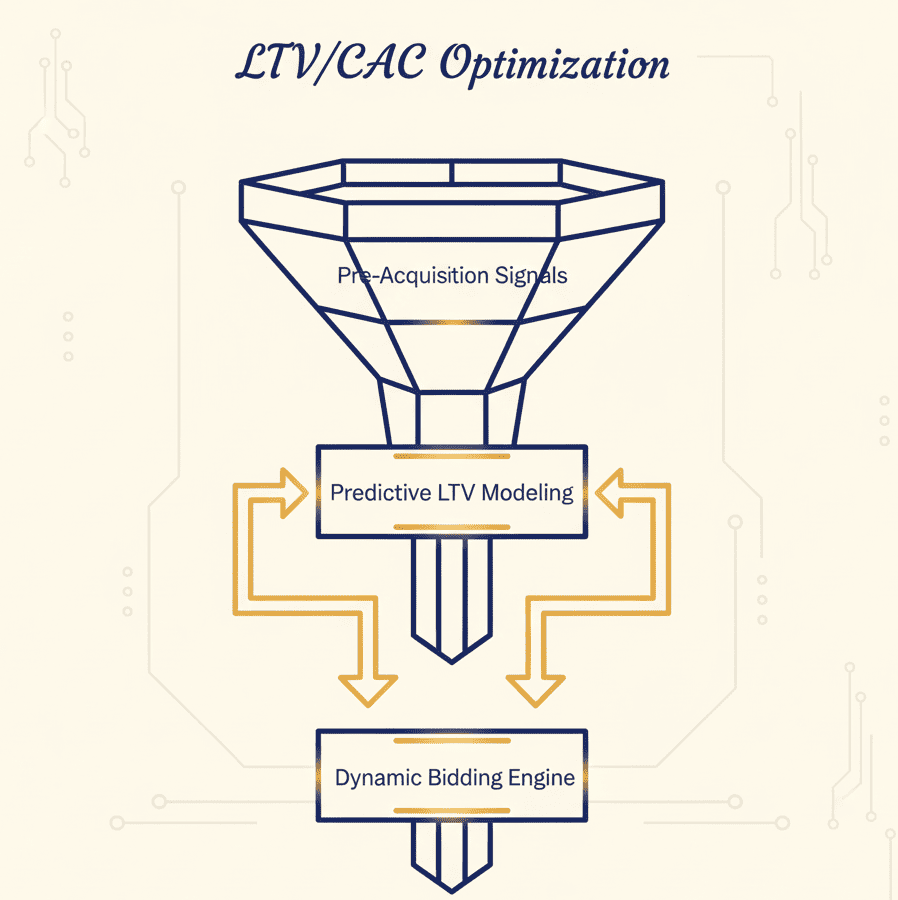
The most significant financial lever in paid media is the shift in the optimization target from short-term CPA to the LTV/CAC ratio. A customer acquired at a higher CPA but with a 3x higher LTV is a superior financial outcome to a customer acquired at a low CPA but who churns within the first month.
Elevion’s strategy is to integrate predictive LTV modeling directly into the media bidding and allocation engine. This is not a post-campaign analysis; it is a real-time, forward-looking mechanism.
We leverage proprietary machine learning models that ingest hundreds of pre-acquisition signals—such as demographic data, on-site behavior, and initial product engagement—to forecast a customer’s future LTV at the moment of acquisition. This LTV forecast is then used to dynamically adjust the maximum permissible bid for that specific user segment.
This approach ensures that our media capital is disproportionately deployed toward high-LTV segments, even if their initial acquisition cost is higher. The result is a financially sound, full-funnel economic strategy where every media dollar is an investment in a predictable future cash flow, not merely a transaction cost. This is the definition of a Return on Ad Spend (ROAS) that is rooted in genuine financial value.
IV. Conclusion: Precision as the Only Sustainable Edge
In a digital ecosystem characterized by platform opacity, rising costs, and intense competition, the margin for error has vanished. The era of optimizing for the click is over. The only sustainable competitive edge is the precision with which a business can execute its media strategy and the causality with which it can measure its financial impact.
Elevion’s methodology transforms paid media from a speculative expense into a highly predictable, risk-adjusted financial instrument. We move our clients from the uncertainty of vanity metrics to the certainty of causal financial outcomes, ensuring that every media dollar deployed is a deliberate investment in future LTV. This is the mandate of the modern Attribution Scientist: to enforce financial accountability and engineer superior, unreplicable ROI.