The Resonance Effect: Building a Brand that is Felt, Not Just Seen
I. The Fallacy of Aesthetic Affinity

Most brands are built on a foundation of sand. They invest millions in logos, color palettes, taglines, and visual identity systems—what we call Aesthetic Affinity—believing that surface-level differentiation will create lasting market position. This is the grand illusion of modern branding: the assumption that narrative without structural fidelity can create defensible value.
The evidence is damning. Consider how quickly competitors replicate visual language. A minimalist aesthetic becomes an industry standard within months. A bold color choice is copied across a category within a quarter. Clever taglines are parodied, then forgotten. Aesthetic Affinity operates in a realm of infinite replicability, where the barriers to imitation are measured in design hours and production costs, not strategic depth.
This approach fails because it confuses visibility with resonance. A brand that exists only in the visual and narrative layer is a brand that exists nowhere at all—it’s a costume without a body, easily stripped away by any competitor willing to hire the same design agency. The customer sees it, perhaps even admires it momentarily, but they do not feel it in their operational reality. There is no structural integration, no embedded dependency, no cognitive capture. The brand becomes interchangeable, and in a world of infinite choice, interchangeability is a death sentence.
The fundamental error is treating brand as an output rather than an architecture. When brand strategy begins and ends with creative expression, it produces artifacts—beautiful, perhaps, but ultimately hollow. These artifacts lack what we call structural fidelity: the perfect alignment between what a brand promises and how it delivers that promise through every operational touchpoint, every customer interaction, every moment of friction eliminated or value created.
II. Structural Fidelity: The Engine of Resonance
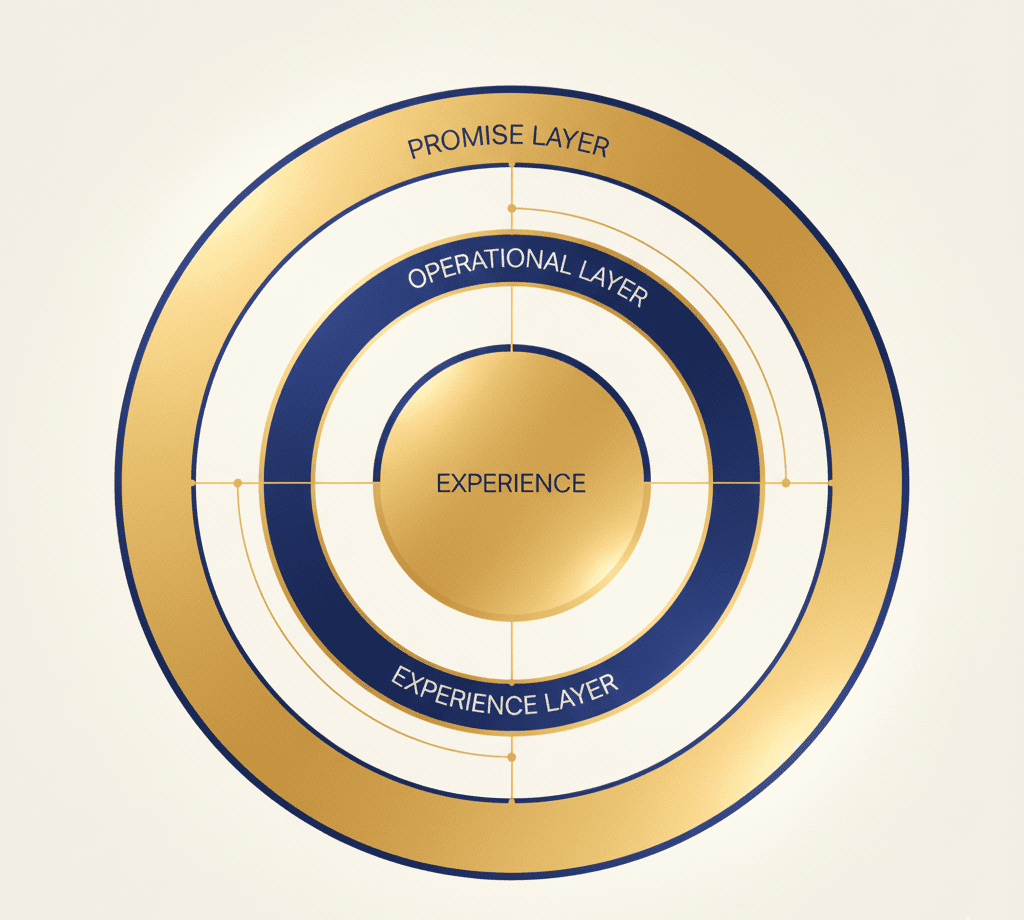
True brand resonance emerges not from what you say, but from the architecture of how you operate. Structural Fidelity is the principle that a brand’s promise must be encoded into the operational DNA of the business—reflected perfectly in product design, customer experience, service delivery, and every micro-interaction that shapes perception.
Consider the difference between a luxury brand that claims “effortless elegance” while subjecting customers to byzantine checkout processes, versus one where every touchpoint—from website navigation to packaging unboxing to post-purchase support—is engineered to eliminate friction and create a sense of ease. The former is narrative dissonance; the latter is structural fidelity. One is forgotten; the other is felt.
Structural Fidelity operates on three integrated layers. First, the Promise Layer: the articulated value proposition that defines what the brand stands for. Second, the Operational Layer: the systems, processes, and capabilities that deliver on that promise. Third, the Experience Layer: the cumulative sensory and emotional reality that customers encounter. When these three layers are in perfect alignment—when the promise is not aspirational but descriptive of actual operational reality—you achieve resonance.
This is not about perfection; it’s about coherence. A brand that promises speed must have supply chain velocity, streamlined interfaces, and rapid response systems. A brand that promises personalization must have data architecture, adaptive algorithms, and human touchpoints that demonstrate genuine understanding. A brand that promises sustainability must have transparent sourcing, circular design principles, and operational practices that withstand scrutiny. The promise becomes the blueprint for operational design.
The power of Structural Fidelity lies in its compounding nature. Each aligned interaction reinforces the brand’s core identity, creating a cumulative cognitive imprint. The customer doesn’t just hear your message; they experience its truth repeatedly, across contexts, until it becomes an internalized expectation. This is how brands move from being chosen to being preferred to being irreplaceable. The brand becomes synonymous not with a visual identity, but with a reliable pattern of value delivery that competitors cannot easily replicate because it requires deep operational transformation, not surface-level mimicry.
III. The Cognitive Moat: Engineering Switching Costs

A brand built on Structural Fidelity creates something far more valuable than loyalty—it creates a Cognitive Moat. This is the defensive perimeter that makes your brand strategically impenetrable, not through legal protection or technological secrets, but through the architecture of customer psychology and operational integration.
The Cognitive Moat operates through two distinct but complementary mechanisms: Emotional Investment and Operational Entanglement. Together, they engineer switching costs that are invisible yet insurmountable.
Emotional Investment is the psychological equity that accumulates when a brand consistently delivers on its structural promise. Each successful interaction deposits value into an emotional account. The customer begins to identify with the brand, not as a consumer choice, but as an extension of their own identity and values. The brand becomes part of their personal narrative—”I’m the kind of person who uses X.” This creates a profound switching cost: leaving the brand feels like abandoning a part of oneself. The loss is not rational; it’s existential. Competitors can match your features, but they cannot transfer the accumulated emotional capital that exists in the customer’s mind.
Operational Entanglement is the structural integration that makes your product or service deeply embedded in the customer’s workflow, habits, and ecosystem. This is achieved through deliberate design: creating interfaces that become intuitive through use, building integrations that connect to other tools in the customer’s stack, establishing data repositories that grow more valuable over time, and designing experiences that adapt to individual preferences. The customer’s operational reality becomes shaped around your product. Switching doesn’t just mean choosing a competitor; it means rebuilding workflows, relearning interfaces, losing historical data, and disrupting established patterns. The friction is not a bug—it’s a feature of strategic design.
The true genius of the Cognitive Moat is that it’s self-reinforcing. As Emotional Investment deepens, customers tolerate more Operational Entanglement. As Operational Entanglement increases, Emotional Investment strengthens because the brand becomes more indispensable. This creates a flywheel effect where the moat widens over time, making competitive displacement exponentially more difficult with each passing quarter.
This is brand as defense mechanism. In a market where attention is fragmented and competition is relentless, the only sustainable advantage is to occupy territory in the customer’s mind that competitors cannot invade. Not because they lack the resources, but because the architecture of switching costs—both emotional and operational—makes displacement economically irrational for the customer.
IV. Activate the Moat Architect

The question is not whether your brand is visible. The question is whether it is defensible. Most brands exist in a state of strategic vulnerability, relying on narrative and aesthetics that can be copied in a single creative sprint. They have built visibility without creating a moat, presence without structural fidelity, awareness without cognitive capture.
The path forward requires a fundamental reorientation. Stop asking “How do we look?” and start asking “How are we felt?” Stop investing in surface differentiation and start engineering operational coherence. Stop treating brand as a creative output and start treating it as an architectural discipline—one that requires the same rigor, systems thinking, and long-term vision as building a fortress.
Assess your current position with brutal honesty. When a customer interacts with your brand, do they experience perfect alignment between promise and delivery? Or do they encounter friction, inconsistency, and dissonance? When they consider leaving, do they feel a sense of loss? Do they face operational barriers that make switching genuinely costly? Or are you just another option in an infinite sea of interchangeable alternatives?
The brands that will dominate the next decade are not those with the most creative campaigns or the largest advertising budgets. They are the brands that understand resonance as a structural phenomenon—those that build Cognitive Moats through the disciplined application of Structural Fidelity. They are the brands that recognize that true differentiation is not aesthetic, but architectural. They are the brands that engineer switching costs into every layer of the customer experience, creating defensive positions that competitors cannot breach.
The choice is yours. You can continue to invest in the illusion of Aesthetic Affinity, hoping that visibility will translate to value. Or you can become a Moat Architect—building a brand that is not just seen, but felt; not just chosen, but irreplaceable; not just present in the market, but impenetrable within it.
The Resonance Effect is not a marketing tactic. It is a strategic imperative. And in a world where every advantage is temporary, the only permanent moat is the one you build in the customer’s mind.