SEO as a Strategic Moat: Building an Impenetrable Digital Advantage and Compounding Asset
By the Chief Digital Strategist and Digital Asset Architect at Elevion
In the executive suite, Search Engine Optimization (SEO) is often relegated to the technical budget—a cost center managed by specialists focused on ephemeral keyword rankings. This perspective is a profound miscalculation of its true financial and strategic value. At Elevion, we view SEO not as a technical task, but as a strategic capital investment in the firm’s future valuation. The primary objective of a sophisticated SEO strategy is not traffic volume; it is the creation of a structural, unreplicable competitive moat—a durable digital asset that generates compounding, high-margin traffic and fundamentally lowers the long-term cost of customer acquisition.
I. The Fiduciary Failure of Tactical SEO

The prevailing model of SEO execution is a fiduciary failure because it prioritizes tactical, short-term gains over structural, long-term asset creation. This approach is characterized by a reactive, volatile, and ultimately unsustainable pursuit of individual keyword rankings.
Most firms engage in what we term “keyword chasing”—a continuous, resource-intensive effort to rank for high-volume, generic terms. This results in traffic spikes that are inherently volatile, highly susceptible to competitive pressure, and easily erased by the next algorithm update. The capital deployed in this manner is not an investment; it is an operational expense that must be repeated ad infinitum.
This tactical myopia fails to build structural authority. When a firm’s digital presence is a collection of siloed, keyword-optimized pages, it lacks the necessary cohesion to withstand market and algorithmic shifts. The result is a digital asset that is fragile, non-defensible, and carries a high risk of obsolescence. This failure to build a durable asset leaves the firm perpetually vulnerable, forcing it to compete on price and paid media, thereby increasing its Customer Acquisition Cost (CAC) and eroding its valuation multiple.
II. Structural Authority: The Architecture of the Digital Moat

The antidote to tactical volatility is the deliberate construction of Structural Authority. This is the strategic framework that transforms a website from a collection of pages into a single, cohesive, and highly defensible digital asset. Structural Authority is achieved by mastering Topical Authority—the comprehensive, expert-level coverage of every relevant sub-topic within a defined niche.
Elevion’s methodology dictates that the goal is not to rank for a single keyword, but to be recognized by the search engine as the definitive, most trustworthy source for an entire subject matter domain. This creates a compounding advantage that is the essence of the competitive moat:
- Synergistic Lift: Every new piece of content benefits all existing content. When a new article is published, it reinforces the site’s expertise, causing a synergistic lift in the rankings of all related pages. The value of the 100th piece of content is exponentially greater than the first.
- Algorithmic Resilience: Structural Authority provides search engine causality—a deep, proven relationship between the site’s content and user intent. This makes the asset highly resilient to minor algorithm updates, as the site’s ranking is based on deep, structural trust rather than ephemeral technical factors.
- Digital Asset Valuation: The site is no longer valued by its current traffic, but by its structural defensibility and its predictable, compounding future traffic. This is a critical factor in digital asset valuation, as it represents a long-term, high-margin revenue stream.
By architecting the content around complete topical clusters, we create a digital asset where the whole is demonstrably greater than the sum of its parts, making the competitive moat virtually impenetrable.
III. Causal Content Strategy: Targeting Intent, Not Volume

To ensure that the traffic generated by Structural Authority translates directly into financial value, Elevion employs a Causal Content Strategy. This strategy shifts the focus from optimizing for high-volume, low-intent keywords to targeting high-intent, financially valuable search queries—a process we call optimizing for keyword covariance.
Traditional SEO chases the largest possible audience, often resulting in high bounce rates and low conversion velocity. Causal Content Strategy, by contrast, is a precise financial filter. We use advanced analytics to identify the specific long-tail, complex queries that correlate most strongly with a high Predictive Lifetime Value (pLTV).
The mechanism is simple:
- Targeted Intent: We focus on the “why” behind the search. A user searching for “best CRM software” is low-intent. A user searching for “integrating Salesforce with proprietary data warehouse API” is high-intent, high-value, and requires a complex, expert-level answer.
- Financial Alignment: By dominating these high-intent, low-volume niches, we ensure that the traffic we acquire is pre-qualified and enters the sales funnel at a higher velocity. This traffic is not only easier to convert but also possesses a higher LTV, as the initial search query itself is a strong signal of a complex, high-value business need.
This strategy ensures that the SEO asset directly feeds the firm’s LTV/CAC models, providing a continuous stream of high-margin customers and fundamentally lowering the long-term Customer Acquisition Cost (CAC).
IV. Conclusion: Valuing Digital Assets
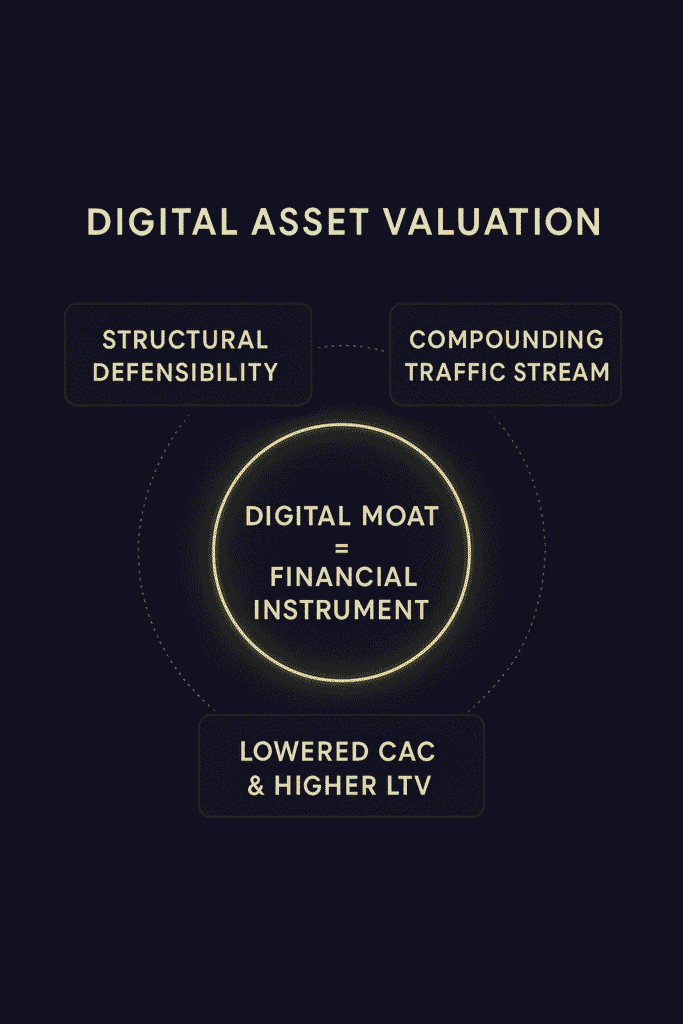
The executive perception of SEO must evolve from a technical expense to a strategic capital investment. The true value of a sophisticated SEO strategy, built on Structural Authority and Causal Content, is its ability to create a durable, measurable digital asset.
This asset generates a compounding advantage that is unreplicable by competitors, providing a long-term, high-margin traffic stream that is resilient to market volatility. By systematically lowering the effective CAC and providing a predictable source of high-LTV customers, superior SEO directly contributes to the firm’s valuation multiple. The digital moat is not a marketing tactic; it is a financial instrument that guarantees long-term, defensible growth.