
The Execution Chasm: Why Your Next Strategy Will Fail—and the Emotional Infrastructure Required to Bridge It
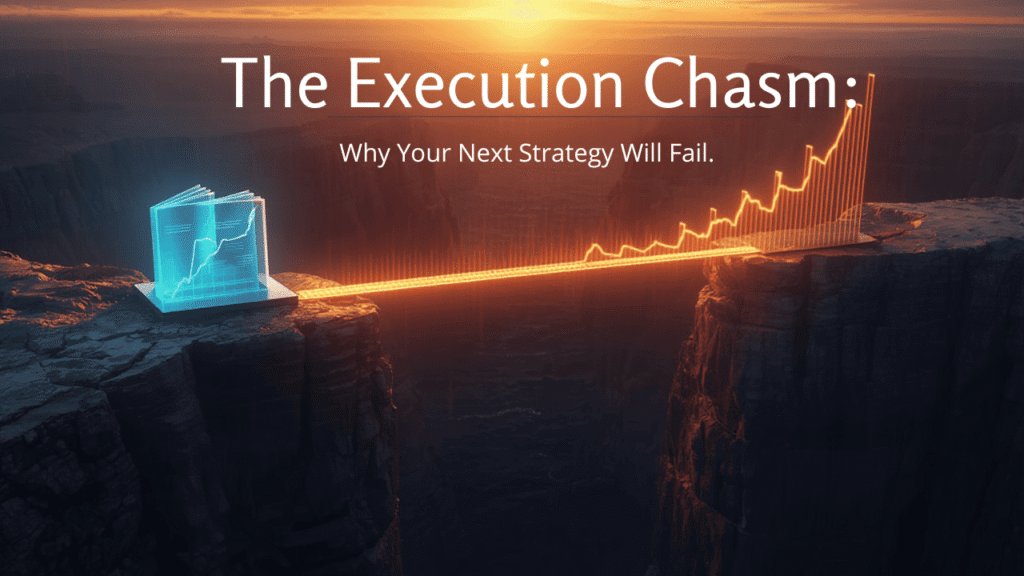
Six months ago, you paid McKinsey $350,000 for a transformation strategy. The deck was brilliant—75 slides of market analysis, competitive positioning, and organizational redesign. Your board loved it. Your executive team nodded in agreement. You felt the familiar surge of conviction that comes with strategic clarity.
Today, that deck sits in a SharePoint folder no one has opened in eight weeks. Your CFO just asked why revenue growth is flat. Your head of sales is executing tactics that contradict the strategy. Your best director left for a competitor because “nothing ever changes here.” Meanwhile, your competitors—with inferior strategies—are somehow pulling ahead.
Here’s the truth nobody in consulting will tell you: Your strategy didn’t fail because the thinking was wrong. It failed because you bought advice when you needed a system. The real chasm isn’t between your current state and your desired future. It’s between executive conviction and organizational execution—and it’s an emotional systems problem, not a capability problem.
The $4 Trillion Problem Traditional Consulting Won’t Solve
Research tells a brutal story: 73% of strategic plans fail between formulation and execution. McKinsey found that even high-performing companies have a 30 percent gap between their strategy’s full potential and what is actually delivered, and only 12% of companies executing major changes achieve or exceed their ambition.
But here’s what makes this a blue ocean opportunity for firms like Elevion (www.thinkelevion.com): the consulting industry has created this problem through its own business model, and structurally cannot fix it.
The Consultant’s Blind Spot: When Insight Becomes the Enemy of Impact
Traditional strategy firms optimize for intellectual brilliance, not implementation psychology. McKinsey, Bain, and BCG built empires on $500-per-hour strategic thinking. Their margins depend on moving from one insight project to the next, never staying long enough to face the hard part: transforming belief into behavior across an organization of skeptical, overworked humans.
This isn’t a criticism of their intellectual horsepower—it’s an observation about structural incentives. When your business model requires rotating to the next $2M engagement every 12-16 weeks, you cannot build the systems that convert strategic conviction into organizational momentum. You architect the cathedral but never lay a single brick.
Bain’s research acknowledges that strategy and execution cannot be separated, yet their engagement model does exactly that. They’ve identified the problem but cannot solve it without cannibalizing their core offering.
The Consultant’s Blind Spot: When Insight Becomes the Enemy of Impact
Traditional strategy firms optimize for intellectual brilliance, not implementation psychology. McKinsey, Bain, and BCG built empires on $500-per-hour strategic thinking. Their margins depend on moving from one insight project to the next, never staying long enough to face the hard part: transforming belief into behavior across an organization of skeptical, overworked humans.
This isn’t a criticism of their intellectual horsepower—it’s an observation about structural incentives. When your business model requires rotating to the next $2M engagement every 12-16 weeks, you cannot build the systems that convert strategic conviction into organizational momentum. You architect the cathedral but never lay a single brick.
Bain’s research acknowledges that strategy and execution cannot be separated, yet their engagement model does exactly that. They’ve identified the problem but cannot solve it without cannibalizing their core offering.
The Agency’s Limitation: Execution Without Authority
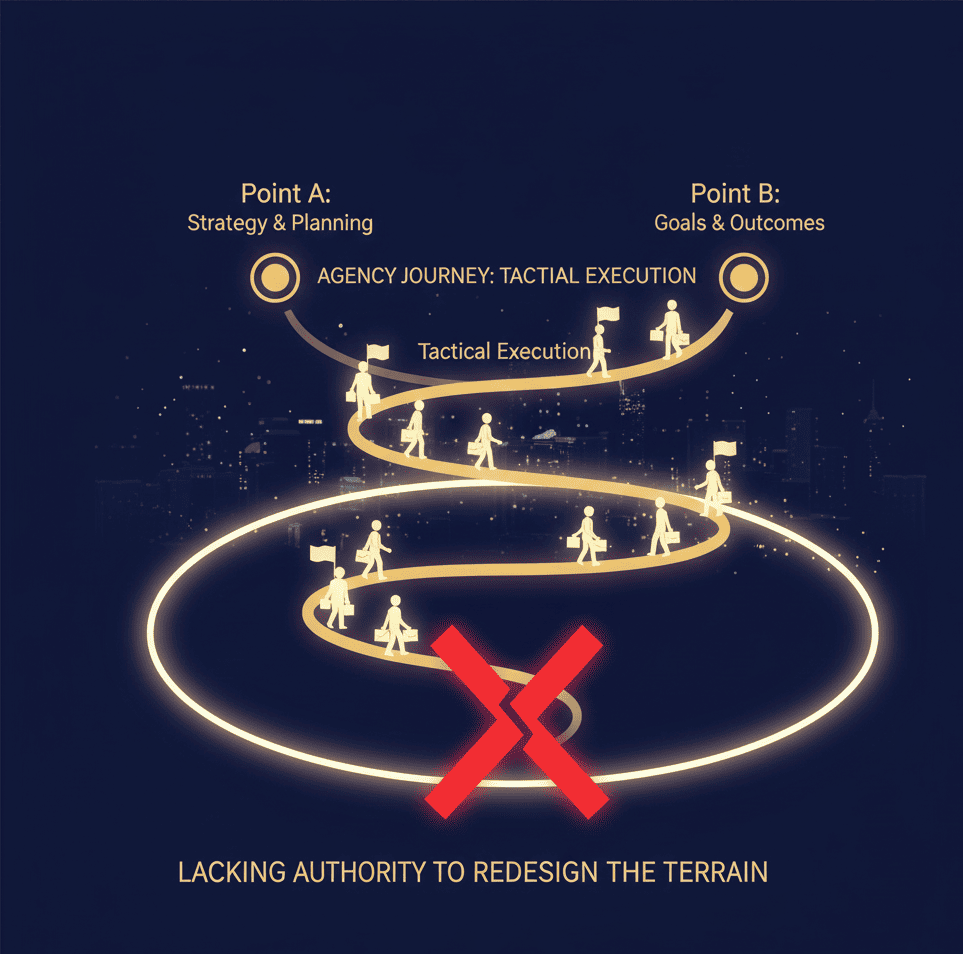
On the other end, digital agencies can execute tactics brilliantly. They’ll optimize your SEO, run your paid acquisition, build your content engine. But they lack three critical capabilities:
- Strategic Authority: They can’t walk into your boardroom and redesign how your organization processes conviction into action
- Organizational Psychology: They don’t have frameworks for identifying and addressing the emotional blockers between strategy and execution
- Compounding Architecture: They optimize for campaign performance, not organizational capacity building
An agency can get you from point A to point B on a map. But they can’t build the infrastructure that makes every subsequent journey faster and more effective.
The Emotional Gap: Where $350,000 Strategies Go to Die
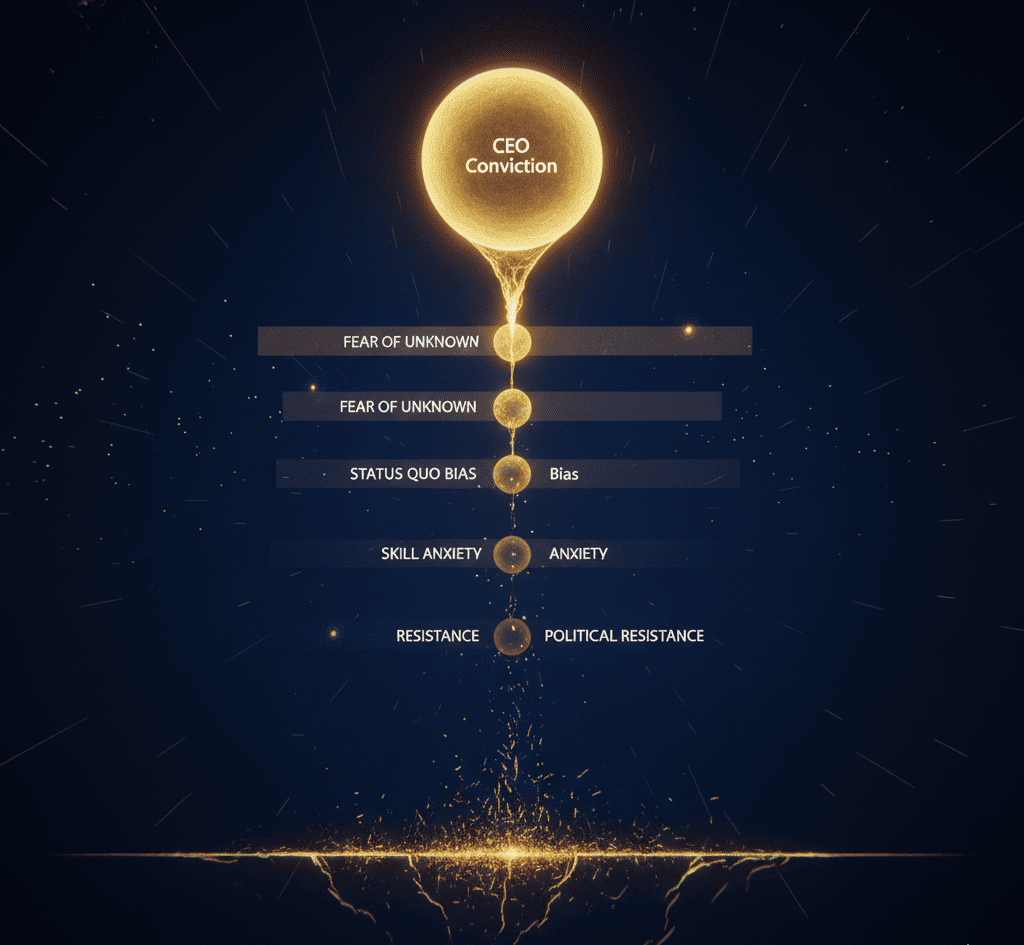
Here’s what actually happens between strategy and execution:
Your CEO understands the strategy intellectually and feels it emotionally. She can evangelize it with conviction. But when that conviction needs to cascade through five layers of management, across 200 employees with competing priorities, against the gravitational pull of “how we’ve always done it”—that’s where the chasm opens.
The blockers aren’t logical. They’re emotional:
- Fear of the Unknown: “What if this new approach fails and I own the failure?”
- Status Quo Bias: “The old way might not be optimal, but at least I know how to succeed at it”
- Skill Anxiety: “I don’t have the capabilities this new strategy requires”
- Political Resistance: “This change threatens my position/influence/resources”
- Resource Scarcity Anxiety: “We can’t afford to do this AND hit our quarterly numbers”
- Team Capability Doubt: “My team isn’t ready for this level of transformation”
- Market Timing Fear: “What if we’re too early/late/wrong about the market shift?”
Deloitte’s “Wheel of Woe” framework identifies emotional and social risks as requiring anticipation of habits, fears, power, social satisfaction, and cultural beliefs that drive resistance to change. But identifying the problem isn’t the same as building systems to solve it.
Traditional consulting firms leave before addressing these emotional blockers because doing so would require staying through implementation—which their business model cannot sustain.
The Third Way: Emotionally Intelligent Growth Systems
What if there were an approach that combined consulting rigor with execution capability—specifically designed to bridge the emotional infrastructure gap?
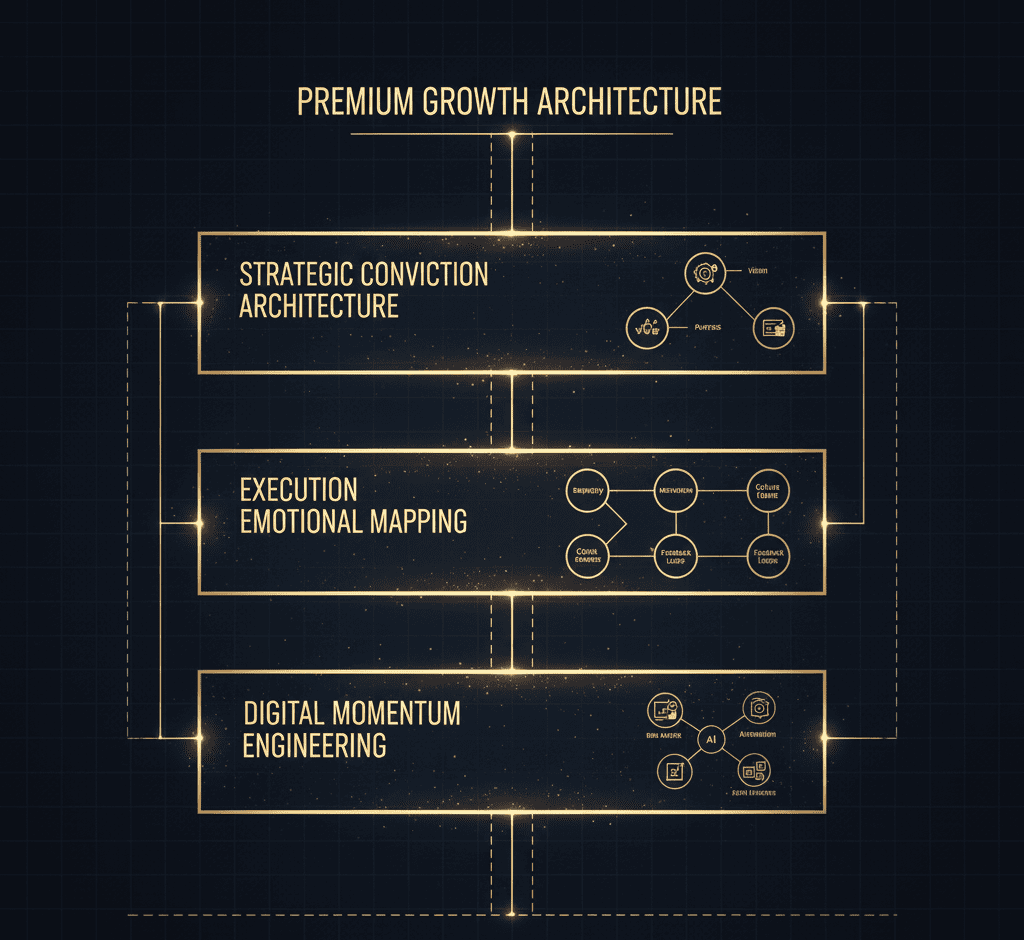
This is the opportunity Elevion has built www.thinkelevion.com around: premium growth architecture that fuses strategic consulting with digital execution psychology. Not bundling two services, but creating an integrated system where strategy and execution reinforce each other emotionally and operationally.
Layer 1: Strategic Conviction Architecture
Most strategies fail the “resonance test”—they make intellectual sense but don’t create emotional voltage. Strategic Conviction Architecture starts by designing strategies that executives can feel and evangelize, not just understand.
This means:
- Crafting strategic narratives with emotional resonance that answer “why should I care?” not just “what should we do?”
- Building conviction through co-creation, not presentation (people support what they help build)
- Creating proof points that let leaders experience early success before making full commitment
- Designing language that mid-level managers can repeat without distortion as it cascades down
Why traditional consulting ignores this: Their timelines don’t allow for the iteration required to build authentic conviction. They present finished thinking, not collaborative discovery. And they measure success by client satisfaction with the deck, not by organizational energy six months later.
Layer 2: Execution Emotional Mapping
This is where Elevion’s approach diverges most sharply from traditional models. We don’t just identify what needs to change—we map the specific emotional blockers at each level of the organization and build micro-systems to address each one.
For a $75M SaaS company shifting from enterprise sales to product-led growth, this looked like:
Blocker Identified: Sales leaders feared PLG would eliminate their roles and destroy the selling culture they’d built.
Emotional System Built:
- Created “expansion specialist” role that repositioned top sellers as high-touch growth drivers for PLG-sourced accounts
- Ran 30-day digital sprint proving PLG could generate qualified pipeline without replacing sales
- Designed compensation model showing sales could earn more in hybrid model than pure enterprise
The digital proof system addressed the fear with evidence, not reassurance. And it happened in 30 days, not 6 months of planning.
This requires BOTH: Strategic authority to redesign roles/incentives AND execution capability to prove concepts through rapid digital validation.
Layer 3: Digital Momentum Engineering
Here’s the unfair advantage: We use internet marketing execution as an “emotional proof system” that creates organizational belief.
When a skeptical VP of Marketing sees organic traffic increase 140% in 60 days through strategic content execution, something shifts. The transformation isn’t theoretical anymore—it’s generating pipeline. That emotional proof creates permission for deeper change.
The 90-day cycle looks like:
Weeks 1-3: Strategic hypothesis + emotional blocker mapping + digital sprint design
Weeks 4-9: Execute digital proof-of-concept (content, paid acquisition, conversion optimization)
Weeks 10-12: Measure momentum + capture organizational energy + refine strategy based on market response
Week 13: Reset for next cycle with compounding infrastructure in place
This isn’t project work. It’s building organizational capacity where each cycle makes the next one faster and more effective. Strategy informs execution; execution validates strategy; validated strategy builds conviction for deeper transformation.
Why agencies can’t deliver this: They lack the strategic frameworks to connect digital execution to organizational transformation. They optimize campaigns, not belief systems.
Why consulting firms can’t deliver this: They don’t have the in-house digital execution capability to run the proof cycles. And their engagement economics require completion, not continuation.
What Makes This Defensible: Why McKinsey Can’t Just Add “Execution”
You might ask: If this gap is so obvious and valuable, why haven’t the major firms filled it?
The answer reveals why this is a genuine blue ocean opportunity, not just a positioning exercise.
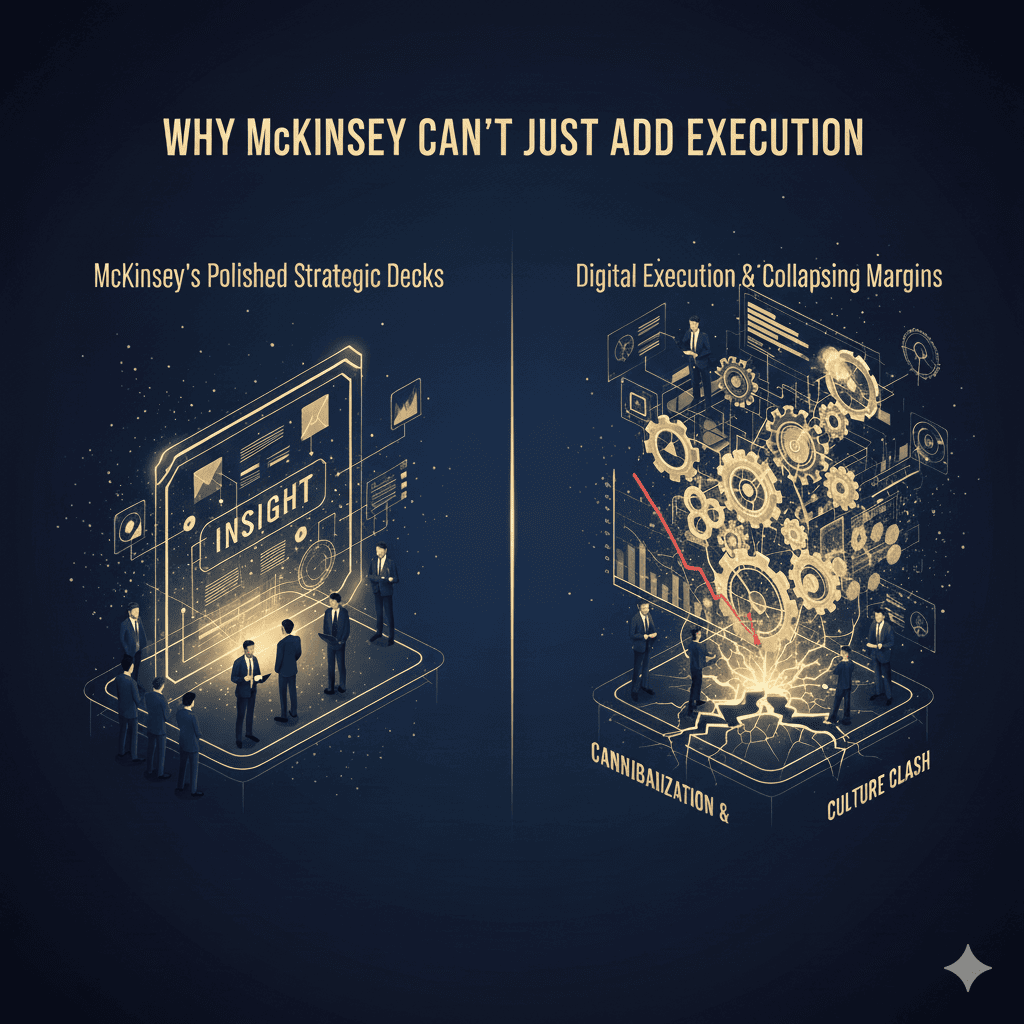
Structural Barrier 1: Business Model Cannibalization
McKinsey’s margin structure requires $300-$500 per hour for partner time and $150-$250 for senior associates. That math works for 12-week strategic engagements where you’re selling insight.
It breaks completely when you’re executing digital marketing campaigns for 18 months. Digital execution requires practitioners (SEOs, content strategists, paid media specialists) who command different rates and produce different margins. Adding execution wouldn’t expand McKinsey’s business—it would dilute it.
More importantly, staying through execution exposes you to a different kind of accountability. When your fee is for strategic thinking, the benchmark is “Did they provide valuable insights?” When you’re executing, the benchmark becomes “Did revenue grow?” That’s a risk traditional firms avoid by design.

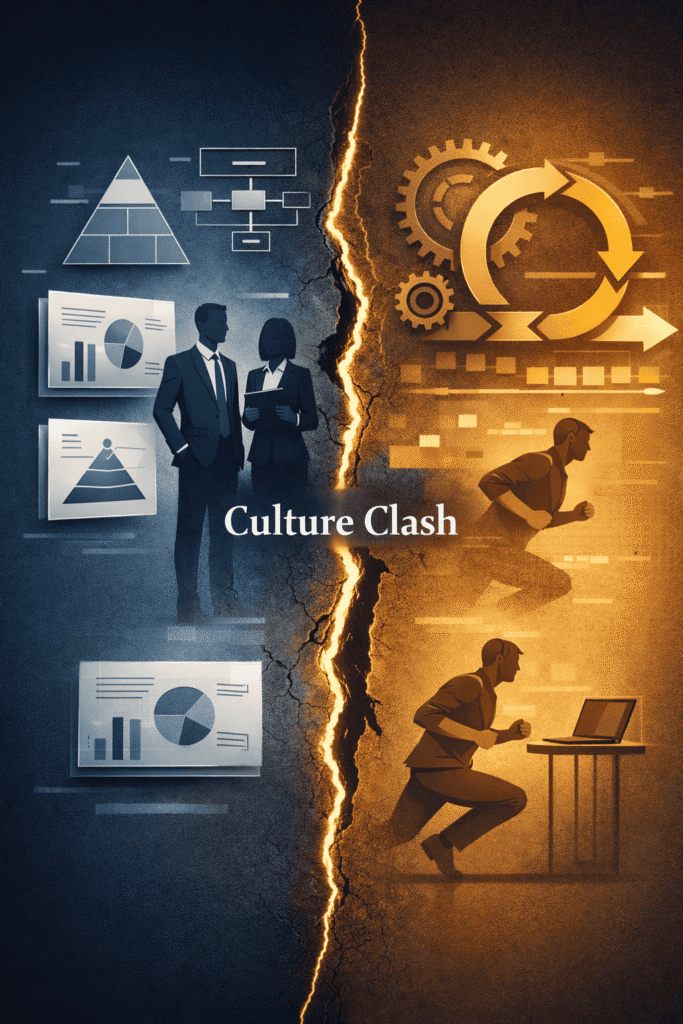
Structural Barrier 2: Talent and Culture Mismatch
The people who excel at strategic consulting (pattern recognition, frameworks, client management through persuasion) are fundamentally different from people who excel at digital execution (bias toward action, comfort with ambiguity, optimization through iteration).
Firms like Bain have experimented with this through initiatives like FRWD (their digital marketing practice), but FRWD focuses on helping clients transform their customer-facing marketing, not building internal execution systems. It’s still advisory on execution, not execution itself.
Building a firm where both cultures thrive requires different hiring, different advancement paths, different metrics of success—essentially, a different company. The consultants would resist because execution doesn’t carry the same prestige. The executors would resist because strategy without implementation frustrates practitioners.
The Category Creation Opportunity
This isn’t about being better at consulting or better at digital marketing. It’s about defining a new category: Premium Growth Architecture.
Traditional consulting sells strategic insight. Agencies sell tactical execution. Elevion builds growth systems where:
- Strategy and execution reinforce each other
- Emotional infrastructure gets designed, not assumed
- Digital proof creates organizational belief
- Each cycle compounds into increasing momentum
We’re not competing with McKinsey for strategy work. We’re not competing with agencies for campaign execution. We’re serving the CEO who’s been burned by both and now understands the gap between them is where transformation actually happens.
Why This Moment Creates Blue Ocean Potential

Three forces make this opportunity particularly acute right now:
- Strategy Commoditization:
Bain’s research found that 94% of leaders in companies over $5 billion identify internal dysfunction—not lack of opportunity—as the main barrier to growth. Strategic frameworks are increasingly similar across firms. The differentiator has shifted from strategic thinking to implementation capacity. - Investor Pressure for Execution:
Private equity and venture capital investors are exhausted by portfolio companies that can articulate strategy brilliantly but can’t execute. Board members increasingly ask: “Who’s going to make this actually happen?” Traditional consulting doesn’t have a good answer. - The Distributed Work Challenge:
With remote and hybrid teams, the emotional transmission of conviction from executive to frontline has never been harder. You can’t rely on physical proximity and cultural osmosis to translate belief. You need explicit systems—which nobody is building.
The Pattern We See Repeatedly
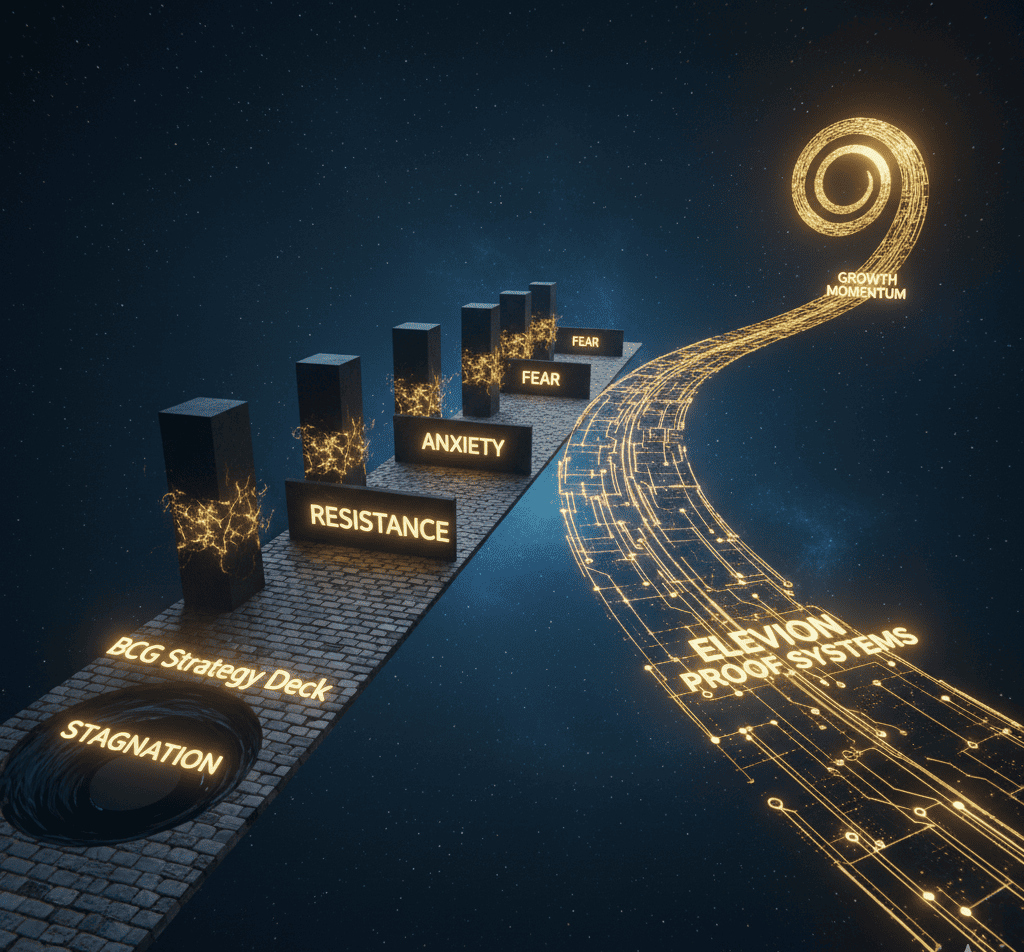
A $120M professional services firm hired BCG to redesign their go-to-market strategy for a platform play. The strategy was sound: move from project-based revenue to platform subscription revenue with compounding network effects.
Eighteen months later, project revenue was still 80% of the business. Why?
The emotional blockers were never addressed:
- Partners feared platform revenue wouldn’t hit their comp targets for 18 months (loss aversion)
- Client-facing teams didn’t know how to sell platform value vs. project delivery (skill anxiety)
- Operations couldn’t see how platform delivery would work with existing infrastructure (implementation overwhelm)
BCG had diagnosed the strategic opportunity accurately. But they left before building the emotional systems to enable execution. The firm ended up stuck between two business models, executing neither well.
When Elevion partners with similar firms, we don’t just design the strategy. We:
- Map the specific emotional resistance at each stakeholder level
- Run digital proof-of-concept campaigns that demonstrate platform economics with real customers
- Build compensation bridges that address loss aversion
- Create 90-day momentum cycles that let teams build confidence through wins, not presentations
The Provocative Truth: You Already Know Your Strategy Will Fail
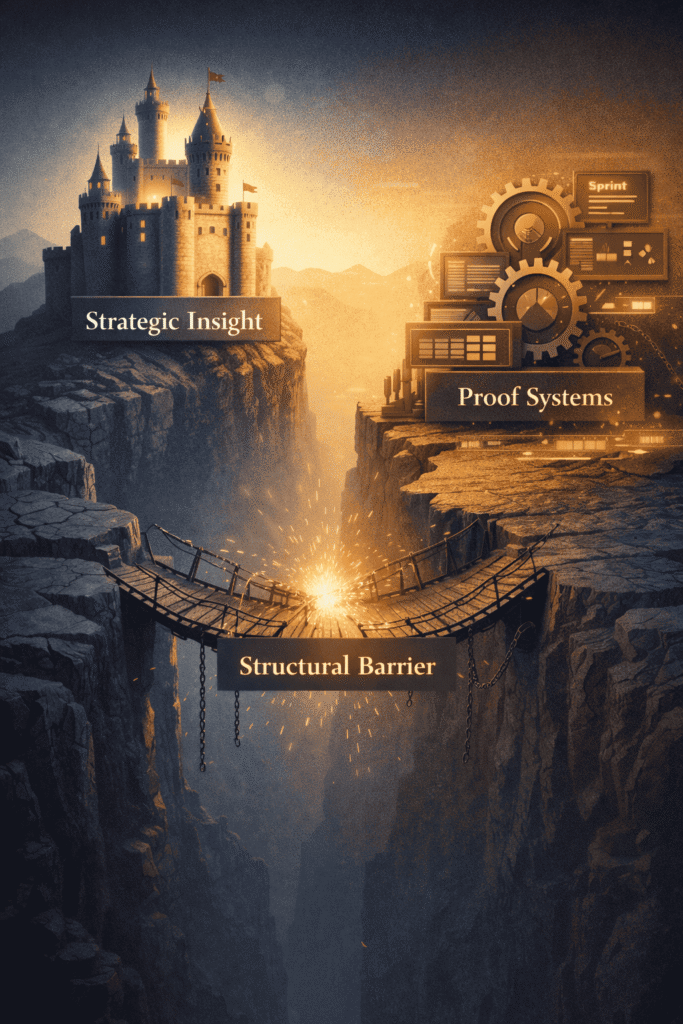
If you’re honest with yourself, you already sense it. That gnawing feeling that your beautiful strategy will meet the same fate as the last one. That the gap between boardroom conviction and frontline execution will swallow another $500K consulting investment.
The question isn’t whether you need better strategy or better execution. The question is whether you’re ready to stop buying advice and start building systems.
Strategy-only consulting leaves you with a deck that nobody executes. Execution-only agencies leave you with activity that doesn’t compound. Premium growth architecture gives you systems where belief becomes behavior, and behavior becomes momentum.
Most organizations will keep cycling through the strategy-then-procurement-then-agency relay race, wondering why momentum never builds. A few will recognize that the gap between those functions is where competitive advantage actually lives.
Those few will win—not because they think differently, but because they’ve built the emotional infrastructure to execute differently.
The Category Question That Defines the Next Decade
In an era where strategic frameworks are commoditized and execution capability is the moat, the question becomes: Who builds the bridge?
Organizations that win won’t just think strategically or execute tactically. They’ll architect growth systems where emotional intelligence meets operational discipline, where conviction cascades into action, where digital proof accelerates organizational belief.
That’s not consulting. That’s not agency work. That’s premium growth architecture—the category that www.thinkelevion.com is building.
The market doesn’t know it needs this yet. But every CEO who’s watched a $350K strategy deck gather digital dust knows exactly what we’re talking about.

Your next strategy will fail. Not because the thinking is wrong, but because you’re buying advice when you need a system. The question isn’t whether you need better strategy or better execution. It’s whether you’re ready for premium growth architecture that fuses both—building not just plans, but the emotional infrastructure required to execute them.
Organizations that win don’t just think differently—they execute emotionally intelligently. That’s the bridge we build at www.thinkelevion.com.