
The Architecture of Scalable Business:
Engineering Organizational Physics for Infinite Growth
Most businesses do not fail due to a lack of product-market fit, insufficient capital, or a deficit of
ambition. They collapse under their own structural weight. This is not a metaphor; it is a
mechanical reality governed by the laws of organizational physics.
In the early stages of a venture, energy is directed outward—toward product, sales, and customer
acquisition. The system is efficient because it is small. However, as the number of nodes
(employees, departments, projects) increases, the energy required to maintain internal cohesion
grows disproportionately. Eventually, a tipping point is reached where the internal cost of
coordination exceeds the marginal revenue of growth. This is the moment of entropy, where the
organization consumes more energy keeping itself alive than it produces in value.
This document is not a manifesto on culture or leadership styles. It is an engineering specification
for designing high-performance enterprises. We are concerned here with structural integrity, signal
velocity, and the elimination of friction. We are moving from the realm of “management” to the
realm of “architecture.”
THE MYTH OF LINEAR GROWTH

The prevailing assumption in traditional management theory is that growth is linear—that a $100
million company is simply a $10 million company multiplied by ten. This is a dangerous fallacy.
As an organism scales, its biology must fundamentally mutate to survive the new gravitational
forces exerted upon it. An ant cannot simply be scaled to the size of an elephant; its exoskeleton
would collapse under the square-cube law. Similarly, the organizational structure that supports a
$10 million business will actively destroy a $100 million business.
Data from McKinsey & Company illustrates this brutality: only 12% of software companies that
reach $100 million in annual revenue successfully bridge the chasm to $1 billion. The remaining
88% stall, shrink, or are acquired for parts. They do not die from starvation; they die from
complexity.
Companies systematically “break” at predictable revenue thresholds—typically around $10M,
$100M, and $1B. These are not arbitrary numbers; they represent phase transitions in complexity.
- At $10M, the “tribal” communication method (everyone knows everyone) fails.
- At $100M, the functional hierarchy (silos of excellence) creates insurmountable latency.
- At $1B, the organization battles systemic entropy, where the default state is decay and disorder.
To survive these transitions, the architect must abandon the goal of “linear scaling” and embrace
“structural metamorphosis.” The architecture must be refactored, not just expanded.
THE MATHEMATICS OF STRUCTURAL DECAY

To understand why organizations slow down as they grow, we must look at the mathematics of
connection. The primary constraint on growth is not capital or talent—it is the cost of
communication. We define this through the lens of network theory.
As an organization grows, the complexity of internal communication (C) increases non-linearly
relative to the number of nodes (n). This is a derivative of Metcalfe’s Law applied to
organizational drag:

In a 10-person startup, there are 45 potential lines of communication. In a 100-person company, that number jumps to 4,950. At 1,000 employees, you are managing nearly half a million potential connection points.
If your architecture relies on “communication” and “alignment” to function, your system will inevitably grind to a halt. The noise-to-signal ratio becomes infinite. This phenomenon introduces what we call the Scalability Coefficient ($\sigma$): a measure of how much operational complexity increases for every 10% growth in revenue.
The Scalability Formula:
In a poorly architected system:
$$\sigma > 1$$
This indicates that complexity grows faster than revenue—a financial death spiral where the cost of coordination eventually consumes all marginal profit.
The Architect’s goal is to engineer a decoupled, modular system where:
$$\sigma < 1$$
When $\sigma$ is less than one, the organization achieves Operating Leverage, where revenue scales exponentially while the complexity of the core remains linear.
Entropy in Enterprise Systems
In thermodynamics, entropy is a measure of the thermal energy of a system per unit temperature
that is unavailable for doing useful work. In an enterprise, “Middle Management” and bureaucratic
processes often act as this thermal energy loss. They absorb kinetic energy (work) and convert it
into heat (meetings, reports, approvals) without generating propulsion (revenue).
Without a Modular Architecture, the cost of coordination eventually exceeds the marginal revenue
of growth. To solve this, we must optimize the Efficiency of a Unit (Eu). This is achieved
through Structural Decoupling, where the efficiency is inversely proportional to the unit’s
dependency on the core (Dc).
We formalize this relationship as:

Here, Output Velocity is the speed at which a unit can deliver value to the market. Dependency
Lag (Dc) represents the sum of all wait times incurred by relying on centralized resources
(e.g., waiting for Legal approval, waiting for IT provisioning, waiting for budget authorization).
If Dc is high—meaning a team cannot move without permission or resources from the center—
Eu approaches zero regardless of how talented the team is. The only mathematical way to
maintain high Efficiency (Eu) at scale is to drive Dependency Lag (Dc) toward zero. This
requires a fundamental shift in design: from integrated monolithic structures to modular,
decoupled systems.
FROM HIERARCHY TO NETWORK: THE MICROSERVICES REVOLUTION
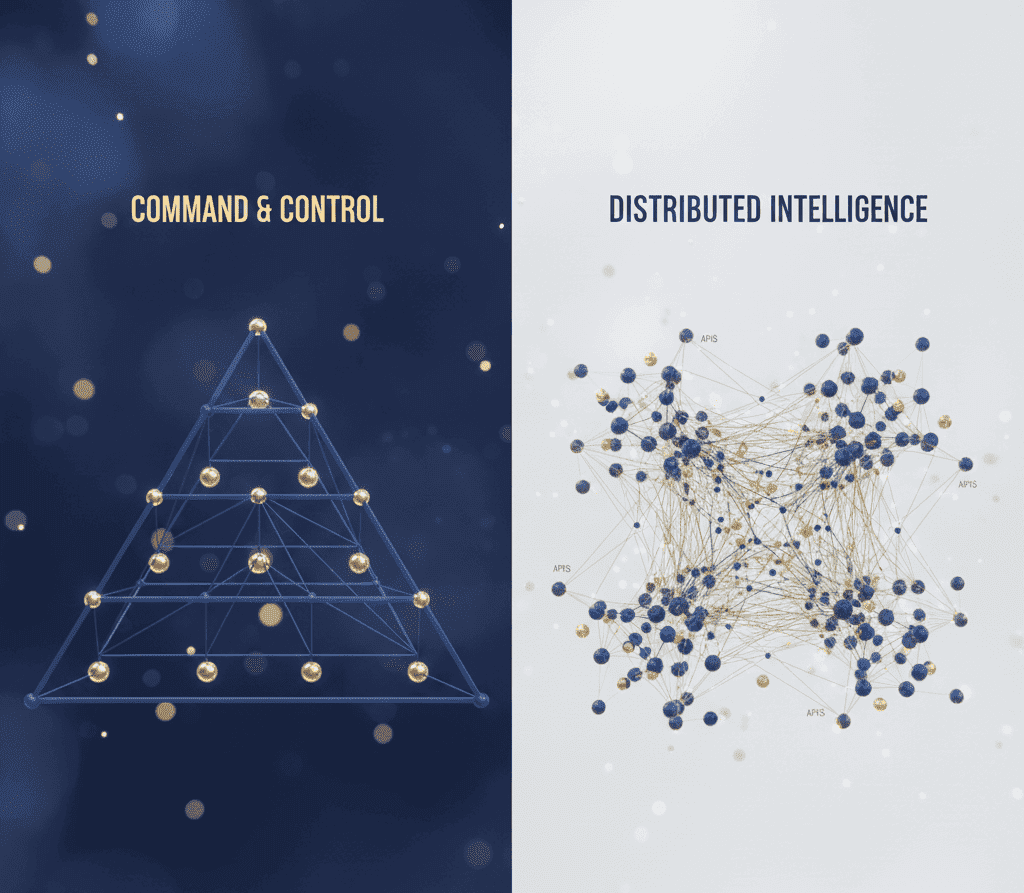
The traditional solution to complexity is the hierarchy: a command-and-control structure designed
to standardize execution. While effective in the industrial age, hierarchy is disastrous in the
information age. Hierarchy assumes that intelligence resides at the top and execution at the
bottom. In a complex, rapidly changing market, this latency is fatal.
The modern architectural paradigm shifts from “Command and Control” to “Distributed
Intelligence.” This is not a vague management philosophy; it is the application of software
engineering principles to organizational design. We call this the Modular Operating Model
(MOM).
Just as modern software applications have moved from monolithic codebases to microservices,
modern enterprises must transition from functional silos to autonomous business units. In this
model, every business unit functions as a plug-and-play microservice.
Case Study: The API-fication of the Enterprise
The most famous implementation of this physics is Amazon’s “API Mandate” issued by Jeff Bezos
in 2002. The directive was not about technology; it was about organizational topology. It required
that all teams expose their data and functionality through service interfaces. No “back-channel”
communication was allowed. This forced Structural Decoupling. It meant that Team A did not
need to have a meeting with Team B to get data; they simply called Team B’s API.
By codifying interactions, Amazon reduced the coordination cost (C) toward zero, allowing
them to scale nodes (n) almost infinitely without the system collapsing.
Similarly, Haier, the Chinese appliance giant, restructured its 80,000 employees into 4,000 “micro-
enterprises” (MEs). Each ME has its own P&L, hiring rights, and profit-sharing rights. They do
not wait for permission; they trade value with each other. Ping An, a financial conglomerate,
utilizes a similar modular architecture to manage over 30 distinct business lines sharing a common
technological substrate.
The Friction-to-Flow Ratio
The metric for success in the Modular Operating Model is the Friction-to-Flow Ratio. This quantifies internal “bureaucratic drag” against output velocity.
- Friction is defined as hours spent on internal coordination (meetings, reporting,
- approvals).
- Flow is defined as hours spent on value creation (coding, selling, designing, shipping
A resilient architecture maximizes Flow by automating or eliminating the sources of Friction via
the MOM framework.
THE TECHNOLOGY SCAFFOLDING: INFRASTRUCTURE AS SKELETON

In the Modular Operating Model, technology is not a support function; it is the structural skeleton
that holds the organization together. You cannot build a distributed network of autonomous units
on top of a centralized, monolithic ERP system.
Cloud-First as a Prerequisite: Modularity requires that resources be elastic and accessible on-
demand. If a business unit must file a ticket and wait three weeks for a server, $D_c$ (Dependency
Lag) spikes, and velocity crashes. Cloud infrastructure allows infrastructure to be provisioned via
code, effectively reducing the friction of resource acquisition to zero.
Digitization as Decoupling: Digitization is often sold as “efficiency,” but its true value is
architectural. When a process is digitized, it can be decoupled from human intervention. A manual
approval process requires a synchronous human interaction (a meeting or email thread). A digital
approval process can be asynchronous and automated. This creates the interface layer necessary
for microservices to interact.
The Strategic Value of Microservices Beyond IT: The concept of the microservice must extend
to the business itself. HR should be an API (Input: Candidate Profile $\to$ Process: Onboarding
Workflow $\to$ Output: Productive Employee). Finance should be an API. When internal
functions are treated as products with defined Service Level Agreements (SLAs), the organization
shifts from a political entity (who you know) to a networked market entity (what you deliver).
ENGINEERING ORGANIZATIONAL PHYSICS
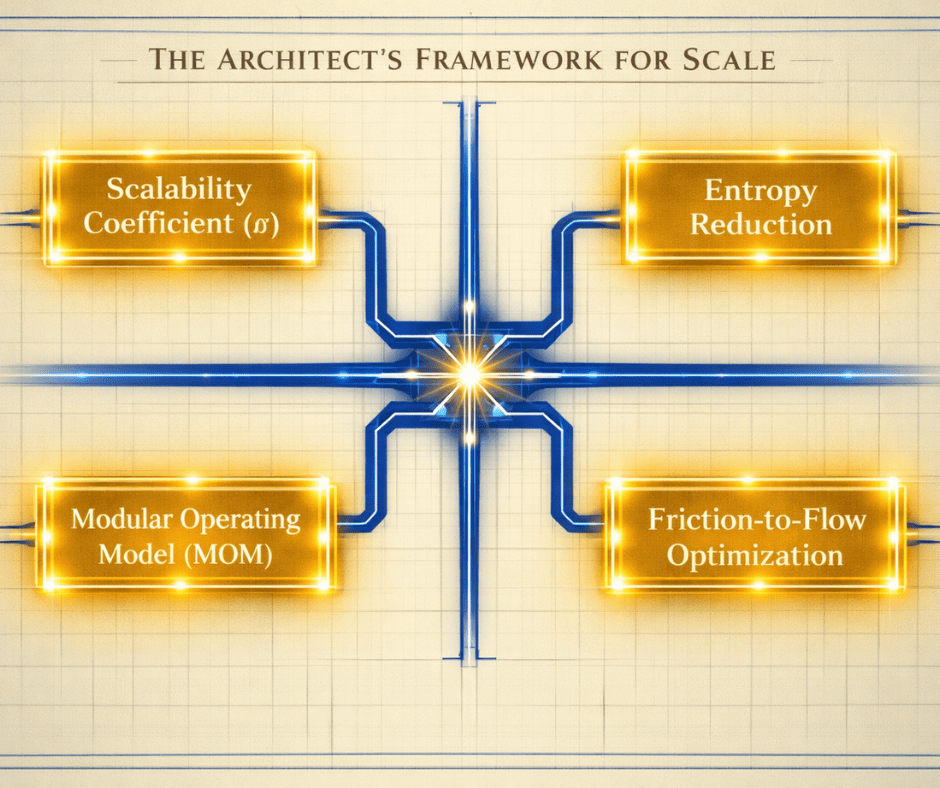
To implement these concepts, the Systems Architect must rigorously apply the proprietary frameworks discussed:
The Architect’s Framework for Scale
- Measure the Scalability Coefficient ($\sigma$): Audit your operational complexity
relative to revenue. If you are hiring support staff faster than you are adding revenue,
$\sigma > 1$. Stop growing and fix the chassis. - Reduce Entropy: Identify the “thermal loss” in your system. Which layers of
management exist solely to move information from one node to another? Replace these
layers with automated dashboards and direct APIs. - Deploy the Modular Operating Model (MOM): Break monolithic departments into
cross-functional, autonomous units. Give them a clear API (what they must deliver) and
total autonomy on the implementation (how they deliver it). - Optimize Friction-to-Flow: aggressive removal of dependencies. If Unit A cannot
function without Unit B, they are not two units; they are one broken unit. Decouple them or
merge them.
The goal is to prevent the cost of coordination (C) from exceeding marginal revenue. By
structurally decoupling units, you artificially lower n (the number of nodes) in any given
equation. A company of 10,000 employees is unmanageable. A network of 1,000 ten-person teams,
connected by clear APIs, is infinitely scalable.
CONCLUSION: THE ARCHITECT’S MANDATE
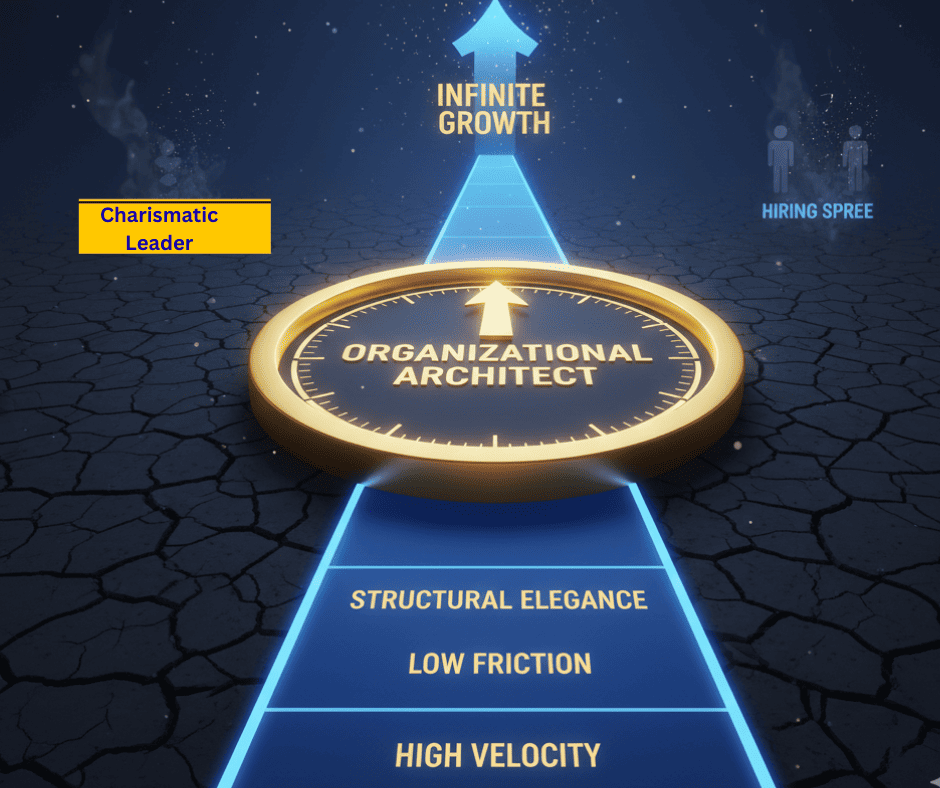
We have reached the end of the era of the “Charismatic Leader” who holds the chaos together
through sheer force of will. We are entering the era of the “Organizational Architect.”
The mandate for the modern CEO is not to hire more people to solve problems. Hiring is often an
admission of failure—a confession that the current system is not efficient enough to handle the
load. The mandate is to design systems that eliminate the need for the problem to exist.
Organizational architecture is the ultimate competitive advantage. Products can be copied. Strategy
can be mimicked. But a system that generates high-velocity output with low internal friction is a
physics engine that competitors cannot reverse-engineer.
Stop managing work. Start engineering the machine that does the work. True scalability is not
about getting bigger; it is about getting smarter about the physics of your own existence. Through
structural elegance, we achieve infinite growth.